📲 Inside the Platform
A Look at Soccer IQ Lab
Real scenarios, positional maps, and pattern-recognition games — built to be clear for an 8-year-old and challenging for a 15-year-old.
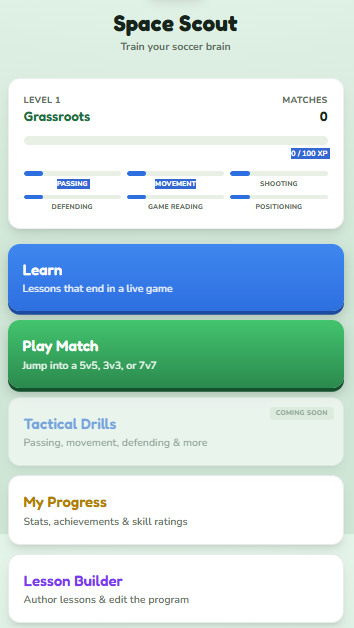
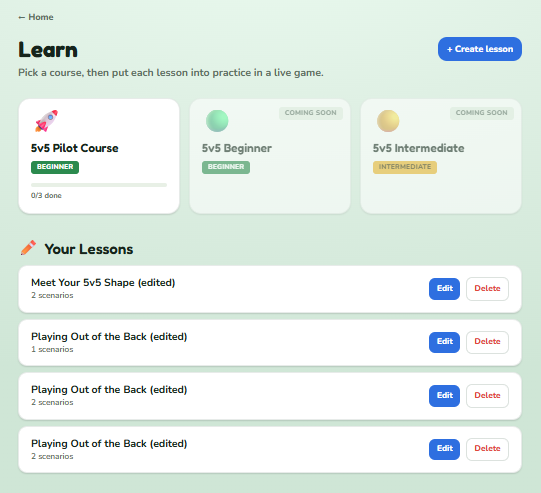
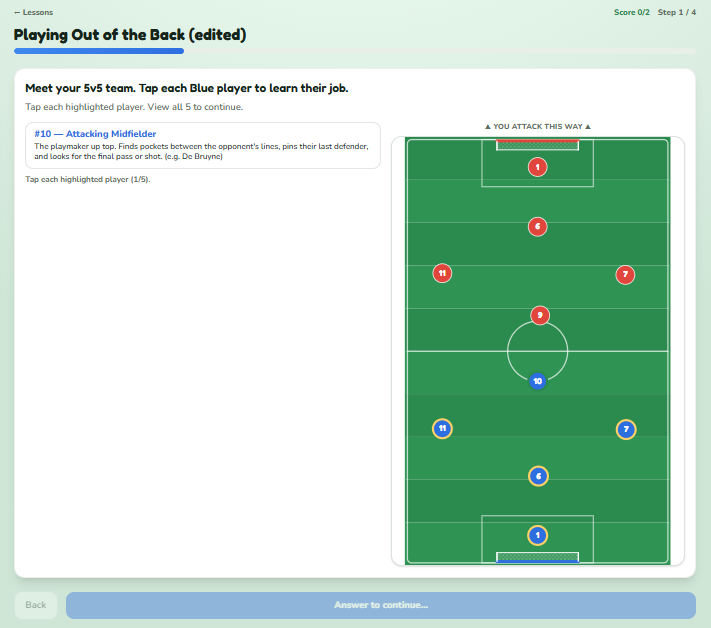
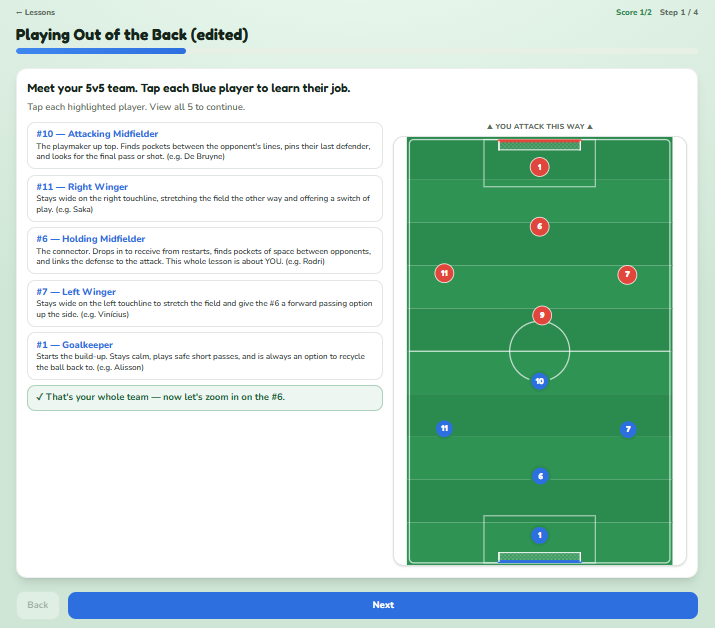
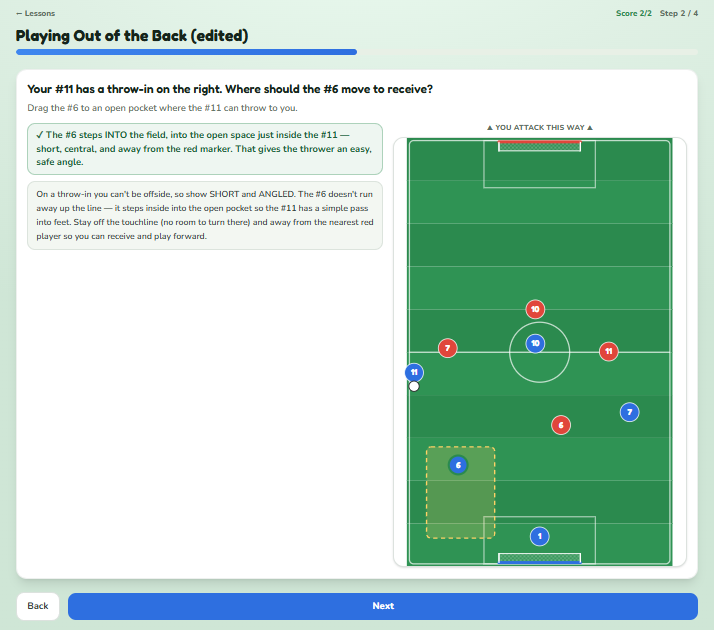
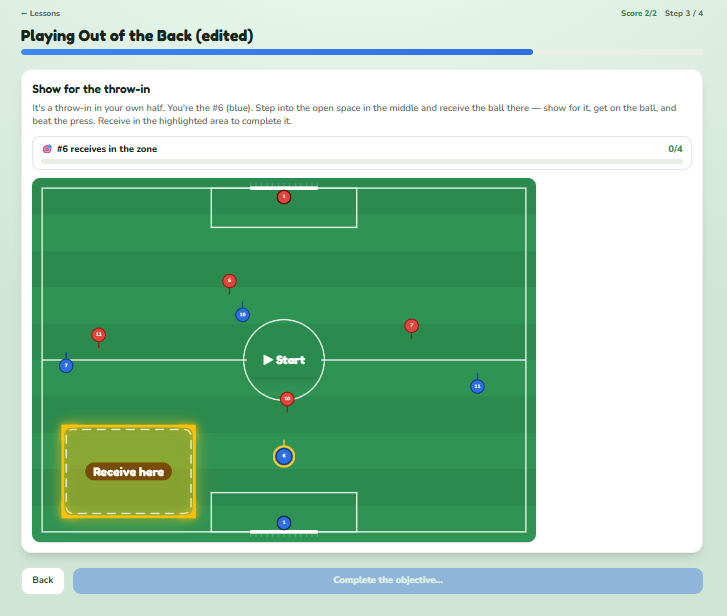
Does your child know where to be on the field?
Most teams train the touch — almost none teach the positioning. Soccer IQ Lab builds the one thing no dribbling app, club practice, or YouTube drill ever does: the ability to read the game, find space, and make the right decision before the ball even arrives.
Real game scenarios, positional maps, and pattern-recognition reps — see the platform your player will use.
Parents tell us the same thing from Texas to New Jersey: their kid has the touches, the speed, the work ethic — and still gets lost in the game.
Your son sees the ball. What he doesn't see — yet — is the pressing trigger developing behind him, the third-man run opening up wide, the gap that just appeared in the defensive line. Elite players see it in real-time. This skill can be trained.
She's technically solid. But when the ball arrives, she hasn't already scanned and decided. She's thinking after the touch instead of before it. The result? Hesitation. Turnover. Frustration on the sideline — from her, not just from you.
Coaches run possession exercises all week. Game day arrives and the same positioning mistakes happen again. Why? Because no one has specifically trained the cognitive layer — the pattern recognition that makes decisions automatic.
The pay-to-play system extracts maximum commitment from families while delivering minimum tactical development. Coaches have 18 players and 90 minutes. Individual game IQ training doesn't exist in that window.
When a player can't find space or position, they disappear from games. That triggers the confidence collapse cycle — playing tentative, not attacking, getting subbed out earlier. The real fix isn't more sprints. It's learning where to be.
There are thousands of dribbling tutorials. There is exactly zero interactive, age-appropriate platforms teaching players to recognize overlapping fullbacks, identify pressing triggers, or understand third-man runs — until now.
"My son is not the most athletically gifted player on the team but he plays regularly because of his ability to see the game in a way others who do have natural ability can't. I've been coaching him to take his IQ skill to the next level and start to see the patterns on the pitch."
— Parent, U12 travel team, Reddit r/youthsoccerNot reacting. Anticipating. Here's what changes when a player trains their soccer IQ the same way they train their first touch.
Before the ball is even played, they've already scanned the field, identified where space will open, and taken the position that makes the next pass inevitable. Coaches call it "always being in the right place." It's learnable.
They stop waiting for instructions and start moving intelligently on their own. Off-ball movement becomes instinctive. They ghost into pockets of space before defenders can close. Teammates start seeking them out.
Confidence in soccer doesn't come from motivation speeches. It comes from knowing what to do in every situation — and having made the right call so many times in training that the game slows down for them.
A player with high soccer IQ stretches defenses, creates passing lanes, and makes teammates better — all without touching the ball. Coaches notice this. Scouts notice this. Teammates feel it.
A smaller player who reads the game beats a faster player who doesn't. Every time. Soccer IQ is the great equalizer — and unlike physical development, it can be trained deliberately, measurably, and at any age.
Burnout comes from feeling lost and ineffective. The antidote is competence. When players understand the game — when they start getting it — the joy comes rushing back. Parents tell us this is the most unexpected outcome.
The first interactive platform built specifically to develop tactical intelligence in youth players ages 7+ — through real scenarios, positional maps, and pattern recognition reps that build automatic understanding.
Every module in Soccer IQ Lab starts with a real game situation — pulled from actual youth and professional matches — and asks your player to solve it before seeing what happened next. Instant feedback. Real patterns. Repeated until it's automatic.
We built this because no app, no coach, and no YouTube channel was doing it. The gap between "technically good" and "actually impactful" is almost always cognitive — not physical.
Every feature in Soccer IQ Lab was designed around a single question: what does a player need to think to make the right decision before the ball arrives?
Interactive tactical diagrams showing exactly where your player should be in every game situation — receiving wide, pressing in a high block, supporting a throw-in, recovering shape. Not general. Position-specific, with the "why" built in. Works for an 8-year-old learning to find space and a 15-year-old mastering overlapping runs.
Real match situations — freeze-framed — where your player chooses what to do next. Then sees what the best players actually chose, and why. Over 200 branching scenarios across every position and age group. Each one builds the mental database that makes game-reading automatic. Real choices. Instant feedback. No theory without context.
Tactical mini-games that turn pattern recognition into instinct. Identify the pressing trigger before the pass is made. Find the third-man run before it's completed. Spot the overlapping fullback before the winger receives. Quick, engaging, 10-minute sessions that fit between homework and dinner — and compound fast.
Upload your child's game footage. Our AI overlays a "ghost" showing exactly where they should have been at each moment — where the space was, what the best positioning looked like. Parents describe watching this for the first time as eye-opening in a way no coach conversation ever was.
Club coaches assign specific IQ modules tied directly to what was practiced that week. If Tuesday was about high press triggers, Thursday's platform session reinforces exactly that concept — with scenarios, maps, and games built around it. Training doesn't end when practice ends.
See exactly which tactical concepts your player has mastered, which are in progress, and which still need reps. Track decision speed, scenario accuracy, and positional understanding over time — with metrics that actually tell you something about game readiness, not just completion.
Real scenarios, positional maps, and pattern-recognition games — built to be clear for an 8-year-old and challenging for a 15-year-old.
Parents and coaches report these changes within the first 30 days. Not because of magic — because of how the brain actually builds pattern recognition.
They stop reacting and start anticipating. They see what's about to happen before it does — and position accordingly. Coaches notice immediately.
Off-ball movement becomes intelligent and purposeful. They ghost into pockets. They stretch the shape. They create passing angles teammates can use.
When you know what to do in every situation, you stop second-guessing. The hesitation disappears. The game feels slower. Decisions feel obvious.
They stop playing the ball backwards just to avoid risk. They recognize the progressive option, have already scanned for it, and execute before the window closes.
They know what the team's shape looks like — and what their job is in every phase of play. They stop getting lost when the formation shifts.
Burnout comes from feeling lost and ineffective. Tactical competence is the cure. When the game starts making sense, the joy comes back. Parents tell us this is the best part.
Marcus has 8+ years of coaching experience at the youth club and semi-professional level. Originally from Chesapeake, VA, his love for the game began at age 10 and quickly became a life-long passion. He is a former player at the College of William & Mary, where he earned First Team All-Conference and All-State honors. He moved to North Carolina in 2015 and began coaching shortly after in both club and private environments.
His approach to player development:
We've heard them all. Here are straight answers — no spin.
Soccer IQ Lab isn't fully public yet — we're refining it with a small group of players, parents, and coaches. Drop your email and you'll be first to know when we officially launch, plus get early access and founding-member pricing. Prefer to jump in now? The free trial is open.
If you're not sure whether this is right for your player's age, level, or situation — just ask. We'll give you a straight answer, not a sales pitch.
Every dribble, every sprint, every set piece — they've practiced. The ability to read the game, find space, and decide before the ball arrives? That's still waiting to be unlocked. Start the free trial today, or join the launch list and we'll let you know the moment full access opens.